Legal Utah Last Will and Testament Form Get This Document Online

Legal Utah Last Will and Testament Form

A Last Will and Testament is a legal document that outlines how a person's assets and responsibilities should be managed after their death. In Utah, this form serves to ensure that your wishes are honored and that your loved ones are taken care of according to your preferences. Understanding how to properly fill out this form is essential for anyone looking to secure their legacy and provide for their family.

Ready to take the next step? Fill out the form by clicking the button below.

Get This Document Online
Article Structure

Creating a Last Will and Testament is a crucial step in ensuring that your wishes are honored after your passing. In Utah, this legal document serves as a guide for distributing your assets and appointing guardians for any minor children. It outlines how your property should be divided, who will manage your estate, and any specific bequests you wish to make. The form also allows you to name an executor, the individual responsible for carrying out your wishes, ensuring that your affairs are settled according to your desires. Additionally, the Utah Last Will and Testament form includes provisions for revoking previous wills, ensuring clarity and reducing the potential for disputes among heirs. By understanding these key components, you can create a will that reflects your intentions and provides peace of mind for both you and your loved ones.

Document Preview

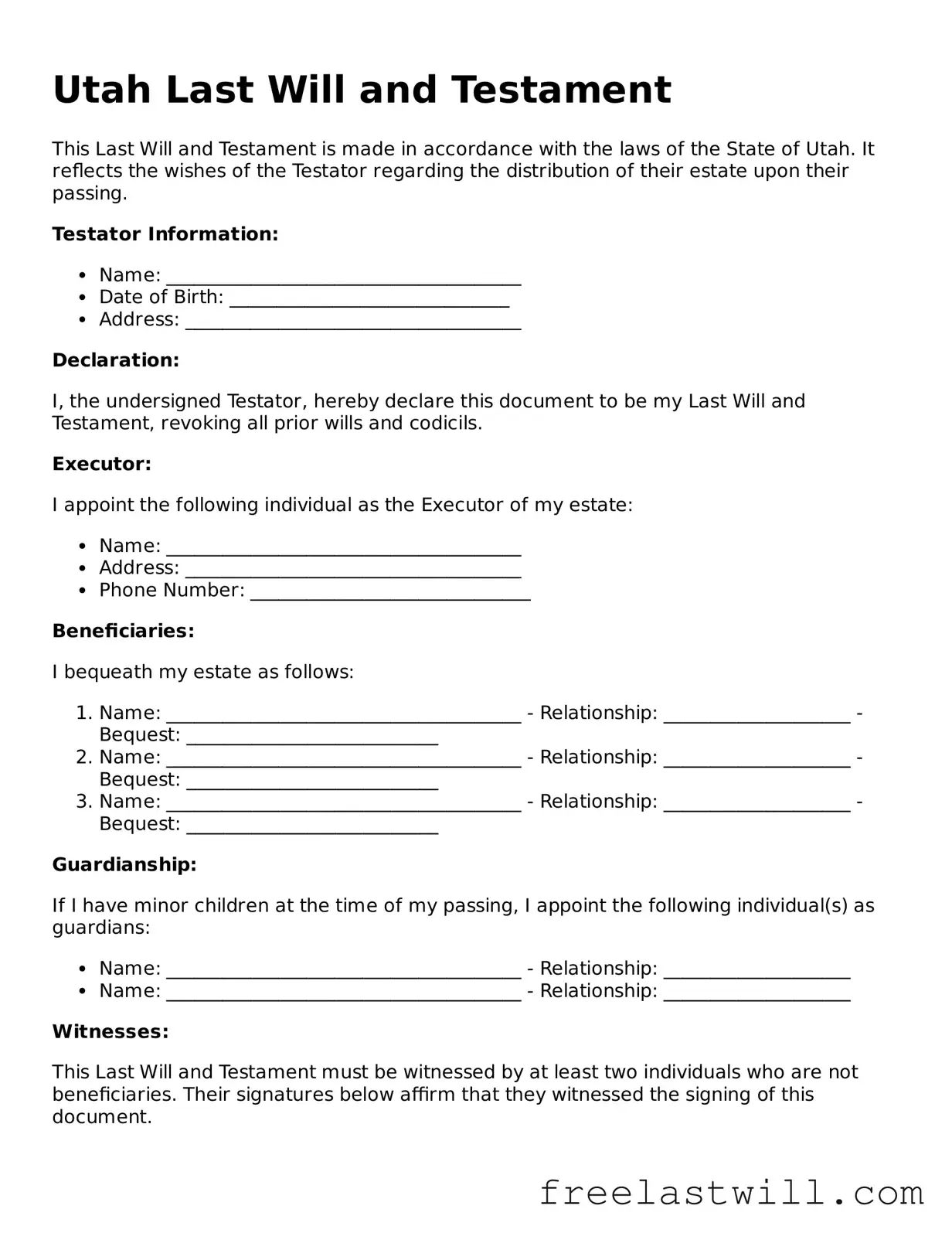
Utah Last Will and Testament

This Last Will and Testament is made in accordance with the laws of the State of Utah. It reflects the wishes of the Testator regarding the distribution of their estate upon their passing.

Testator Information:

  • Name: ______________________________________
  • Date of Birth: ______________________________
  • Address: ____________________________________

Declaration:

I, the undersigned Testator, hereby declare this document to be my Last Will and Testament, revoking all prior wills and codicils.

Executor:

I appoint the following individual as the Executor of my estate:

  • Name: ______________________________________
  • Address: ____________________________________
  • Phone Number: ______________________________

Beneficiaries:

I bequeath my estate as follows:

  1. Name: ______________________________________ - Relationship: ____________________ - Bequest: ___________________________
  2. Name: ______________________________________ - Relationship: ____________________ - Bequest: ___________________________
  3. Name: ______________________________________ - Relationship: ____________________ - Bequest: ___________________________

Guardianship:

If I have minor children at the time of my passing, I appoint the following individual(s) as guardians:

  • Name: ______________________________________ - Relationship: ____________________
  • Name: ______________________________________ - Relationship: ____________________

Witnesses:

This Last Will and Testament must be witnessed by at least two individuals who are not beneficiaries. Their signatures below affirm that they witnessed the signing of this document.

  1. Name: ______________________________________ - Signature: ________________________ - Date: ____________________
  2. Name: ______________________________________ - Signature: ________________________ - Date: ____________________

In witness whereof, I have hereunto set my hand this ____ day of ____________, 20__.

Signature of Testator: ______________________________________

PDF Specifications

Fact Name Details
Governing Law The Utah Last Will and Testament is governed by the Utah Code, Title 75, Chapter 2.
Requirements The will must be in writing, signed by the testator, and witnessed by at least two individuals.
Revocation A will can be revoked by a subsequent will or by destroying the original document with the intent to revoke.
Age Requirement To create a valid will in Utah, the testator must be at least 18 years old.

Instructions on Utilizing Utah Last Will and Testament

After obtaining the Utah Last Will and Testament form, it is essential to fill it out accurately. This ensures that your wishes regarding the distribution of your assets are clearly stated. Follow the steps below to complete the form properly.

  1. Begin with your full name. Write it clearly at the top of the form.
  2. Provide your current address. This should include your street address, city, state, and zip code.
  3. State your date of birth. Use the format MM/DD/YYYY for clarity.
  4. Designate an executor. This person will carry out your wishes as outlined in the will. Include their full name and contact information.
  5. List your beneficiaries. Specify who will inherit your assets. Include their full names and relationship to you.
  6. Detail your assets. Clearly describe each asset and its intended beneficiary.
  7. Include any specific bequests. If there are particular items you want to leave to specific individuals, list them here.
  8. Sign and date the form. Ensure you do this in the presence of witnesses, if required.
  9. Have witnesses sign the form, if necessary. Check state requirements for the number of witnesses needed.

Once you have completed the form, review it carefully for any errors. It’s crucial to keep the signed will in a safe place and inform your executor of its location. Consider consulting with a legal professional to ensure everything is in order.

More About Utah Last Will and Testament

What is a Last Will and Testament in Utah?

A Last Will and Testament is a legal document that outlines how a person's assets and affairs should be handled after their death. In Utah, this document allows you to specify who will inherit your property, name guardians for your minor children, and appoint an executor to manage your estate. It ensures that your wishes are respected and helps avoid confusion or disputes among family members.

Who can create a Last Will and Testament in Utah?

In Utah, any adult who is at least 18 years old and of sound mind can create a Last Will and Testament. This means you should be able to understand the nature of your actions and the consequences of your decisions. If you are a minor or deemed mentally incapacitated, you cannot create a valid will.

What are the requirements for a valid will in Utah?

To ensure your will is valid in Utah, it must meet the following requirements:

  • The will must be in writing.
  • You must sign the will or have someone sign it on your behalf in your presence.
  • At least two witnesses must sign the will, confirming that they witnessed your signature or that you acknowledged it in their presence.

Following these guidelines helps prevent challenges to the will's validity after your passing.

Can I change or revoke my will in Utah?

Yes, you can change or revoke your will at any time while you are still alive. To do this, you can create a new will that explicitly states your intention to revoke the previous one or make changes through a codicil, which is an amendment to your existing will. Just remember that any changes must also meet the same requirements for validity as your original will.

What happens if I die without a will in Utah?

If you pass away without a will, your estate will be distributed according to Utah's intestacy laws. This means the state will determine how your assets are divided, typically prioritizing spouses, children, and other relatives. Dying without a will can lead to outcomes that may not align with your wishes, so it’s important to have a will in place to ensure your preferences are honored.

Common mistakes

  1. Not including all assets: Many people forget to list all their assets. This can lead to confusion and disputes after passing. Make sure to include real estate, bank accounts, and personal belongings.

  2. Failing to name an executor: An executor is responsible for carrying out the wishes outlined in the will. Omitting this important role can complicate the probate process.

  3. Not being specific about beneficiaries: Vague language can create uncertainty. Clearly identify who will receive what to avoid misunderstandings among family members.

  4. Neglecting to sign the will: A will must be signed to be valid. Some people forget this crucial step, rendering the document ineffective.

  5. Not having witnesses: In Utah, two witnesses must sign the will. Failing to include them can invalidate the document. Ensure that witnesses are present when signing.

  6. Using outdated forms: Laws can change, and using an old version of the will form may lead to issues. Always check for the latest version and requirements.

  7. Not reviewing the will regularly: Life changes, and so should your will. Failing to update it after major events like marriage, divorce, or the birth of a child can lead to unintended consequences.

Documents used along the form

When creating a Last Will and Testament in Utah, several other forms and documents may be relevant to ensure that your estate planning is comprehensive. These documents can help clarify your wishes and provide guidance to your loved ones. Below is a list of commonly used forms that often accompany a will.

  • Living Will: This document outlines your preferences for medical treatment in case you become incapacitated. It specifies the types of life-sustaining treatments you do or do not want.
  • Durable Power of Attorney: This form designates someone to make financial decisions on your behalf if you are unable to do so. It remains effective even if you become incapacitated.
  • Health Care Power of Attorney: Similar to a durable power of attorney, this document allows you to appoint someone to make medical decisions for you if you are unable to communicate your wishes.
  • Trust Agreement: A trust can help manage your assets during your lifetime and distribute them after your death. This document outlines how the trust will operate and who will manage it.
  • Beneficiary Designations: Many financial accounts and insurance policies allow you to name beneficiaries directly. These designations can override your will, so it's important to keep them updated.
  • Letter of Intent: While not a legal document, a letter of intent can provide additional guidance to your executor and family about your wishes regarding your estate and funeral arrangements.
  • Pet Trust: If you have pets, this document can specify who will care for them and how funds should be allocated for their care after your passing.
  • Guardianship Designation: If you have minor children, this document allows you to name a guardian for them in the event of your death or incapacity.

Incorporating these documents into your estate plan can help ensure that your wishes are honored and that your loved ones are taken care of. It is advisable to consult with a legal professional to ensure all documents are properly drafted and executed.

Similar forms

The Utah Living Will is a document that allows individuals to express their wishes regarding medical treatment in the event they become incapacitated. Like the Last Will and Testament, it is a legal instrument that outlines personal preferences. However, while a Last Will deals with the distribution of assets after death, a Living Will focuses on healthcare decisions. Both documents require clear intentions and must be executed according to state laws to ensure they are valid.

The Utah Power of Attorney is another important document that shares similarities with a Last Will and Testament. This form grants authority to another person to make financial or medical decisions on behalf of the individual. While a Last Will takes effect after death, a Power of Attorney is effective during a person's lifetime, especially when they are unable to make decisions for themselves. Both documents require careful consideration and should be drafted with the individual's wishes in mind.

The Utah Revocable Living Trust serves a similar purpose to a Last Will but operates during a person's lifetime. This trust allows individuals to manage their assets and specify how they should be distributed upon death. Unlike a Last Will, which must go through probate, a Revocable Living Trust can help avoid this process, providing privacy and efficiency. Both documents require clear instructions and are crucial for estate planning.

The Utah Declaration of Guardian is another related document. It allows individuals to appoint someone to take care of their minor children in the event of their death or incapacity. Like a Last Will, it is essential for ensuring that personal wishes are respected regarding guardianship. Both documents are vital for parents to ensure their children's well-being and should be executed thoughtfully.

Finally, the Utah Bill of Sale is a document that can be similar in its function of transferring ownership. While it primarily deals with the sale of personal property, it can be included in estate planning to transfer specific assets. A Bill of Sale and a Last Will both serve to clarify intentions regarding property, but they differ in their application and timing of transfer. Each document plays a unique role in ensuring that an individual's wishes are honored.

Dos and Don'ts

When filling out the Utah Last Will and Testament form, it's important to be careful and thorough. Here are some key dos and don'ts to keep in mind:

  • Do ensure you are of sound mind when completing the form.
  • Do clearly state your wishes regarding the distribution of your assets.
  • Do name an executor who you trust to carry out your wishes.
  • Do sign the document in front of two witnesses who are not beneficiaries.
  • Don't use vague language that could lead to confusion about your intentions.
  • Don't forget to update your will if your circumstances change, such as marriage or the birth of a child.
  • Don't neglect to keep your will in a safe but accessible place.

Following these guidelines can help ensure that your wishes are honored and that the process goes smoothly for your loved ones.

Misconceptions

Understanding the Last Will and Testament form in Utah is crucial for effective estate planning. However, several misconceptions can lead to confusion. Here are six common misunderstandings:

  1. All wills must be notarized to be valid.

    This is not true. In Utah, a will can be valid without a notary if it is signed by two witnesses. Notarization can add an extra layer of authenticity, but it is not a legal requirement.

  2. Only lawyers can create a will.

    While legal assistance can be beneficial, it is not mandatory. Individuals can create their own wills using templates or forms, as long as they meet the state’s requirements.

  3. Handwritten wills are not valid.

    This misconception overlooks the fact that Utah recognizes holographic wills, which are handwritten and signed by the testator. However, they must still meet specific criteria to be valid.

  4. A will can be used to manage all aspects of an estate.

    A will primarily addresses the distribution of assets after death. It does not cover matters like health care decisions or financial management during incapacity, which require separate documents.

  5. Once a will is created, it cannot be changed.

    This is incorrect. A will can be amended or revoked at any time before death, as long as the testator is mentally competent. Changes can be made through a codicil or by drafting a new will.

  6. Wills are only for wealthy individuals.

    Every adult should consider having a will, regardless of their financial situation. A will ensures that personal wishes are honored and can simplify the probate process for loved ones.

By understanding these misconceptions, individuals can better navigate the process of creating a valid and effective Last Will and Testament in Utah.

Key takeaways

When filling out and using the Utah Last Will and Testament form, consider the following key takeaways:

  1. Clear Identification: Clearly identify yourself as the testator, including your full name and address. This establishes your intent and ensures there is no confusion about who is creating the will.
  2. Executor Appointment: Designate a reliable executor. This person will be responsible for carrying out your wishes as outlined in the will. Choose someone you trust to manage your estate effectively.
  3. Beneficiary Designation: Specify your beneficiaries. Clearly state who will inherit your assets. Be precise to avoid any disputes among family members or friends.
  4. Legal Requirements: Ensure the will is signed and witnessed according to Utah law. A valid will requires your signature and the signatures of at least two witnesses who are not beneficiaries.

Following these guidelines will help create a valid and effective Last Will and Testament in Utah.

Legal Utah Last Will and Testament Form

Get This Document Online