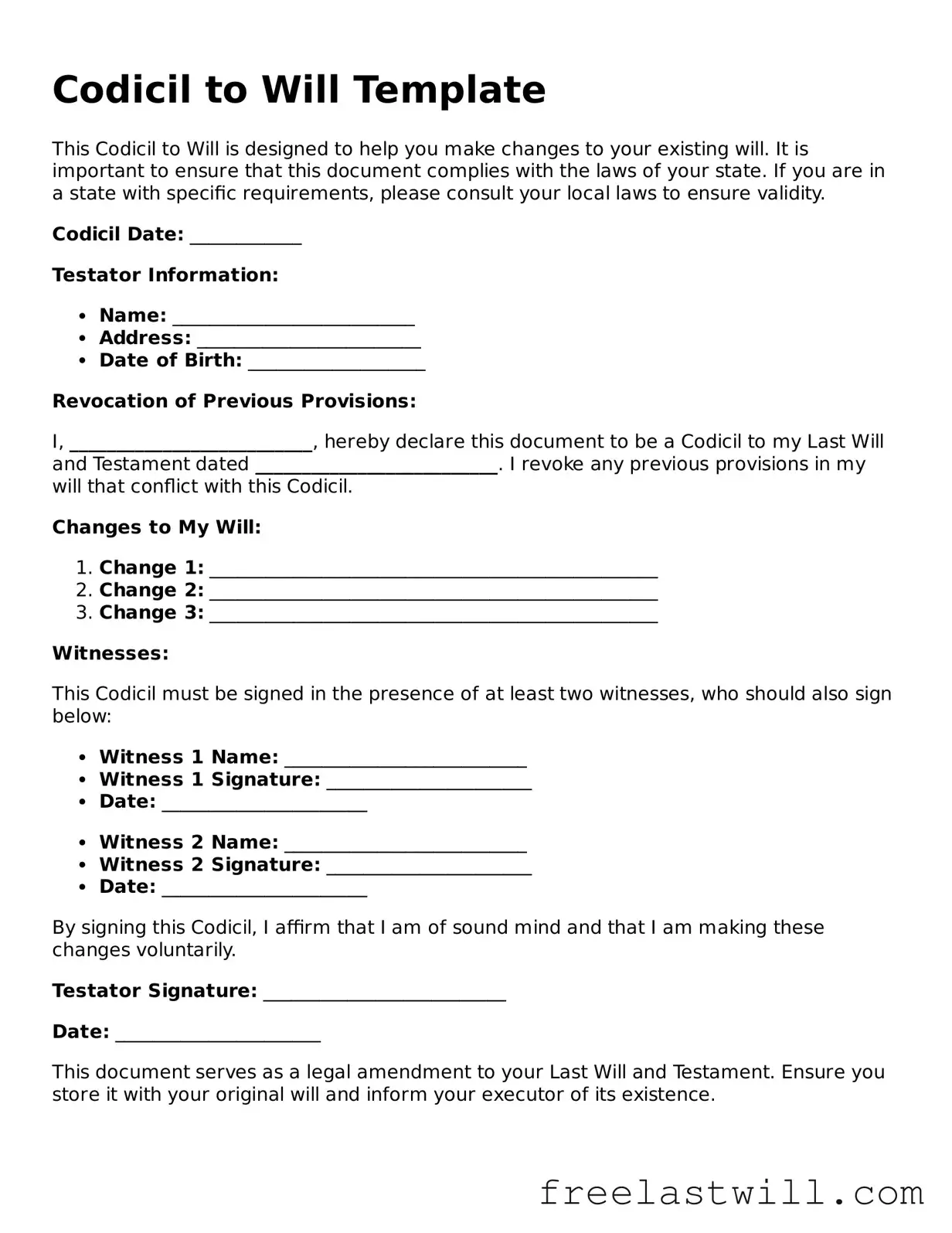
What is a Codicil to a Will?
A codicil is a legal document that allows an individual to make changes to an existing will without having to rewrite the entire document. It can be used to add new provisions, modify existing ones, or revoke certain parts of the will. A codicil must be executed with the same formalities as a will, which typically includes signing in the presence of witnesses.
When should I use a Codicil?
A codicil is appropriate when you want to make minor changes to your will. Some common reasons to use a codicil include:
-
Adding a new beneficiary.
-
Changing the executor of the will.
-
Updating the distribution of assets.
-
Revoking specific bequests.
If the changes are significant, it might be better to create a new will entirely.
How do I create a Codicil?
To create a codicil, follow these steps:
-
Clearly title the document as a "Codicil to Last Will and Testament."
-
Reference your original will, including the date it was executed.
-
State the specific changes you wish to make.
-
Sign the codicil in the presence of witnesses, as required by your state laws.
Ensure that all parties involved understand the changes being made to avoid confusion in the future.
Do I need a lawyer to create a Codicil?
While it is not legally required to have a lawyer draft a codicil, consulting with one can provide clarity and ensure that the document meets all legal requirements. A lawyer can help avoid potential issues that might arise from improperly executed documents.
Can I revoke a Codicil?
Yes, a codicil can be revoked. This can be done by creating a new codicil that explicitly states the revocation or by physically destroying the codicil. It is important to ensure that the revocation is clear to prevent any confusion regarding your intentions.
How does a Codicil affect my original Will?
A codicil modifies the original will but does not replace it. The original will remains in effect, and the changes made by the codicil are incorporated into it. If there are conflicts between the original will and the codicil, the terms of the codicil will take precedence.
While there is no universal format for a codicil, it should include essential elements such as:
-
Your name and address.
-
A statement identifying the original will.
-
The specific changes being made.
-
Your signature and the signatures of witnesses.
Using a clear and organized format helps ensure that the codicil is legally valid and easily understood.