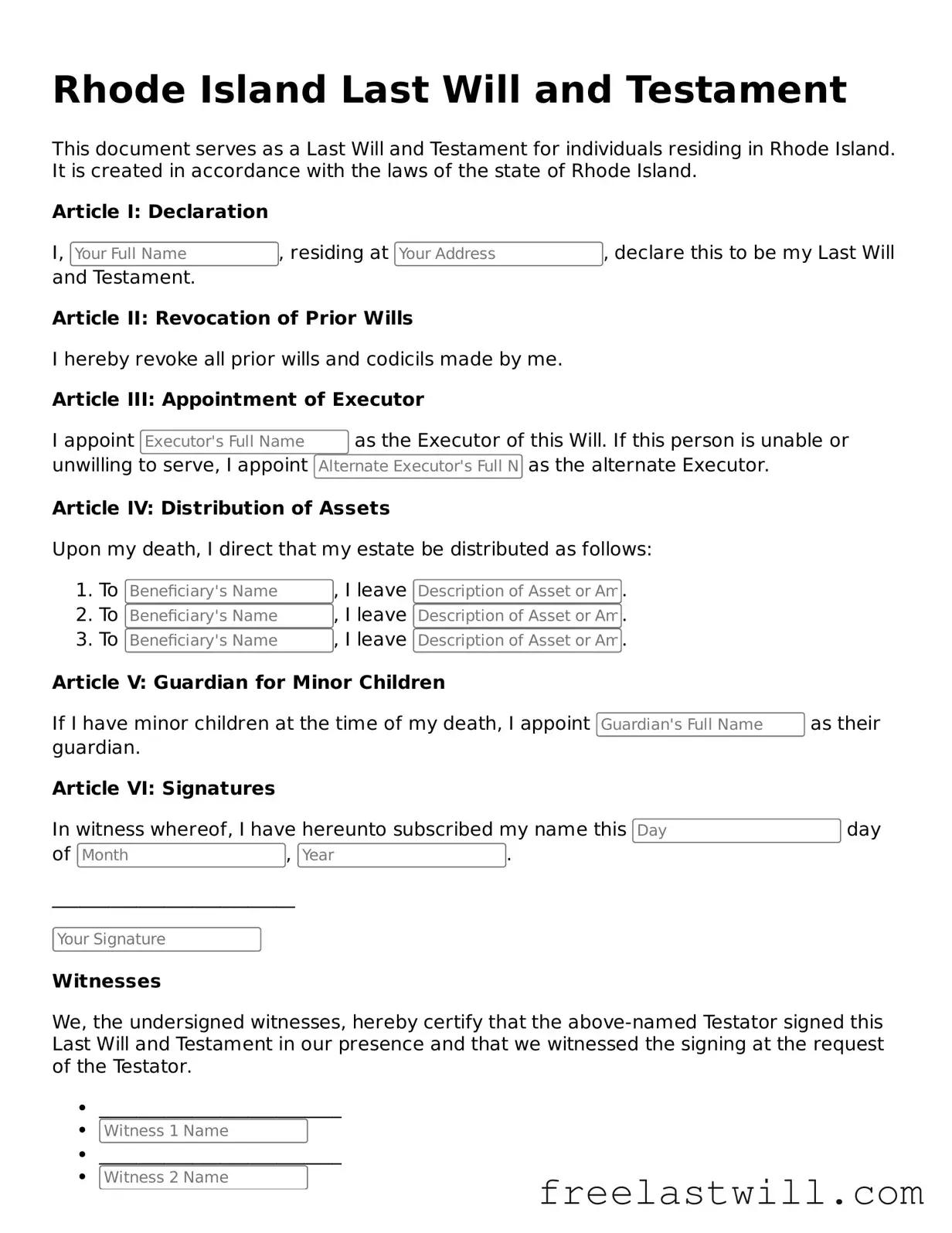
The Rhode Island Last Will and Testament form is similar to a Living Will, which outlines a person's preferences for medical treatment in case they become unable to communicate their wishes. While a Last Will deals with the distribution of assets after death, a Living Will focuses on healthcare decisions during a person's life. Both documents are essential for ensuring that an individual's wishes are respected, but they serve different purposes in estate planning.
Another document akin to the Last Will is a Durable Power of Attorney. This legal instrument allows a person to designate someone else to make financial or legal decisions on their behalf if they become incapacitated. Like a Last Will, it provides clarity about one's intentions, but it operates during a person's lifetime rather than after death. Both documents are crucial for effective estate management.
A Revocable Trust shares similarities with the Last Will in that it allows for the distribution of assets upon death. However, a Revocable Trust can also manage assets during a person's life, offering flexibility and privacy. Unlike a Last Will, which typically goes through probate, a Revocable Trust can help avoid that process, making it an attractive option for many individuals.
The Advance Healthcare Directive is another document related to the Last Will. It combines aspects of a Living Will and a Durable Power of Attorney for healthcare, allowing individuals to specify their medical preferences and appoint someone to make healthcare decisions on their behalf. Both documents aim to ensure that a person's wishes are honored, particularly when they cannot express them directly.
A Codicil is a legal document that amends an existing Last Will. It allows individuals to make changes without creating an entirely new Will. This document is essential for those who want to update their wishes regarding asset distribution or other provisions while maintaining the original structure of their Last Will.
The Financial Power of Attorney is similar to the Durable Power of Attorney but focuses specifically on financial matters. This document enables someone to manage another person's financial affairs, such as paying bills or managing investments. Like the Last Will, it is crucial for ensuring that one's financial interests are protected, particularly in cases of incapacity.
A Joint Will is a single document executed by two individuals, typically spouses, that outlines their mutual wishes regarding asset distribution. While it serves a similar purpose to a Last Will, a Joint Will is often less flexible, as it generally cannot be changed after one party passes away. This makes it a unique option for couples who want to ensure their wishes align.
A Testamentary Trust is created within a Last Will and comes into effect upon the testator's death. This type of trust allows for the management of assets for beneficiaries, particularly minors or those who may not be financially responsible. It shares the goal of a Last Will in asset distribution but adds a layer of management and protection for the beneficiaries.
The Declaration of Trust is another document that can resemble a Last Will in terms of asset management. This document outlines the terms of a trust, detailing how assets will be managed and distributed. Unlike a Last Will, which is focused on post-death asset distribution, a Declaration of Trust can also govern assets during a person's lifetime, providing a comprehensive approach to asset management.
Finally, a Letter of Instruction, while not a legal document, is often used alongside a Last Will. This letter provides personal guidance to executors and family members about funeral arrangements, asset distribution, and personal wishes. While it does not hold legal weight like a Last Will, it can complement it by offering clarity and additional context regarding a person's desires.