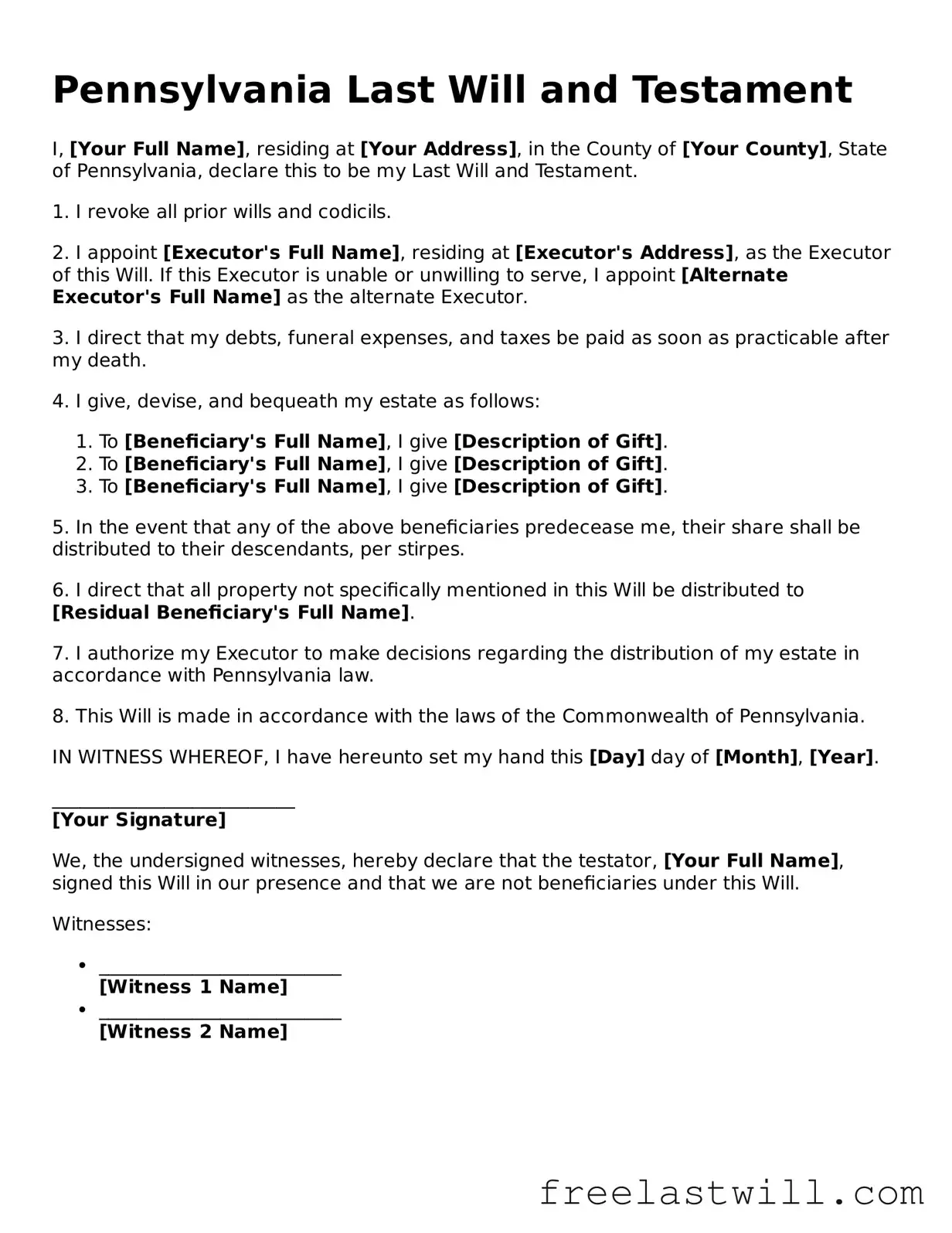
The Pennsylvania Last Will and Testament is similar to a Living Will, which outlines an individual’s preferences regarding medical treatment in the event they become unable to communicate their wishes. While a Last Will primarily deals with the distribution of assets after death, a Living Will focuses on healthcare decisions during life. Both documents reflect personal choices and intentions, ensuring that an individual's wishes are respected when they can no longer express them.
Another comparable document is a Durable Power of Attorney. This legal instrument allows an individual to designate someone to make financial or legal decisions on their behalf if they become incapacitated. Like a Last Will, it is a proactive measure that ensures one's affairs are managed according to their wishes. However, while a Last Will takes effect after death, a Durable Power of Attorney is effective during the individual’s lifetime.
A Revocable Trust shares similarities with a Last Will in that it also directs the distribution of assets upon death. However, a Revocable Trust can be altered or revoked during the grantor's lifetime, offering more flexibility. This document helps avoid probate, allowing for a quicker transfer of assets to beneficiaries, which can be an advantage over a Last Will that must go through the probate process.
The Advance Healthcare Directive combines elements of both a Living Will and a Durable Power of Attorney for healthcare decisions. It allows individuals to specify their medical treatment preferences and appoint someone to make healthcare decisions on their behalf. Like a Last Will, it ensures that personal wishes are honored, particularly in critical health situations.
A Codicil is an important document that amends an existing Last Will and Testament. It allows individuals to make changes without creating an entirely new will. This document must be executed with the same formalities as the original will to be valid. Codicils provide a straightforward way to update beneficiaries or modify terms while maintaining the original will's integrity.
Similar to a Last Will, a Letter of Intent is a non-legal document that provides guidance to loved ones regarding an individual's wishes after death. While it does not have the legal weight of a will, it can clarify intentions and offer personal messages to beneficiaries. This document can complement a Last Will by providing additional context and emotional support to those left behind.
A Testamentary Trust is created through a Last Will and Testament and takes effect upon the individual’s death. It allows for the management of assets on behalf of beneficiaries, often for minors or individuals who may not be financially responsible. This type of trust ensures that the deceased's wishes regarding asset distribution are followed while providing protection for the beneficiaries.
A Joint Will is another document that resembles a Last Will. It is created by two individuals, typically spouses, and outlines how their assets will be distributed upon the death of one or both parties. While it serves a similar purpose, it is important to note that a Joint Will can be more difficult to modify, as both parties must agree to changes, making it less flexible than individual Last Wills.
Lastly, a Pour-Over Will is designed to work in conjunction with a trust. It directs any assets not already placed in the trust to be transferred into it upon death. This ensures that all assets are managed according to the terms of the trust, providing a seamless transition of asset management and distribution. Like a Last Will, it serves to finalize the distribution of an individual’s estate but does so within the framework of a trust.