Legal Oregon Last Will and Testament Form Get This Document Online

Legal Oregon Last Will and Testament Form

A Last Will and Testament is a legal document that outlines how a person's assets and responsibilities will be handled after their death. In Oregon, this form serves as a crucial tool for individuals to express their wishes regarding the distribution of their property and the care of any dependents. Understanding the importance of this document can help ensure that your intentions are honored, so consider filling out the form by clicking the button below.

Get This Document Online
Article Structure

Creating a Last Will and Testament is an essential step for anyone looking to ensure their wishes are honored after they pass away. In Oregon, the Last Will and Testament form serves as a legal document that outlines how an individual’s assets and property should be distributed. This form allows you to name an executor, who will be responsible for carrying out your wishes, and it can also specify guardians for any minor children. Additionally, it provides the opportunity to express any specific bequests, such as gifts to family members or charities. Understanding the key components of this form is vital, as it helps to prevent disputes among heirs and ensures that your intentions are clearly communicated. By taking the time to complete the Oregon Last Will and Testament form, you can bring peace of mind to yourself and your loved ones, knowing that your affairs will be handled according to your preferences.

Document Preview

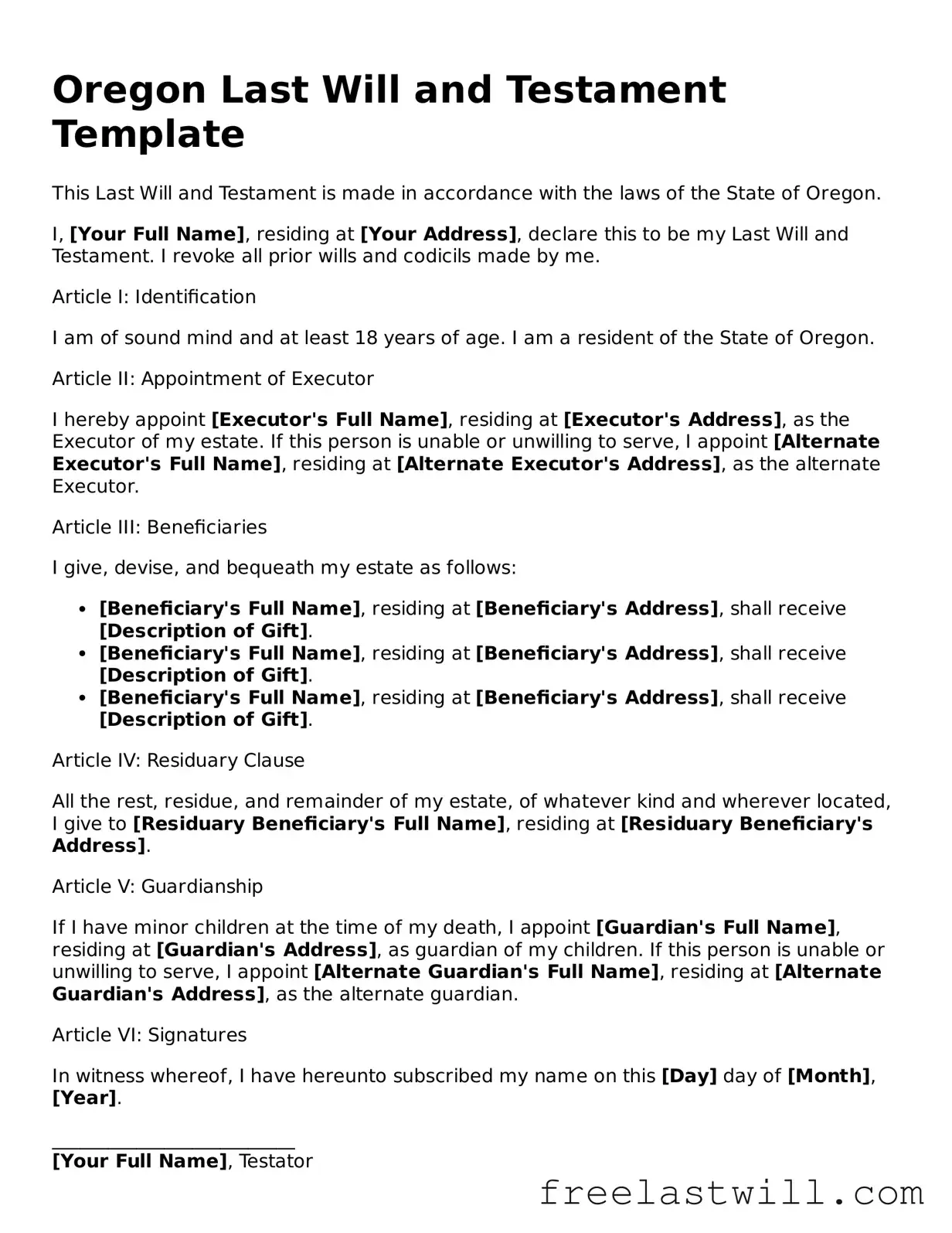
Oregon Last Will and Testament Template

This Last Will and Testament is made in accordance with the laws of the State of Oregon.

I, [Your Full Name], residing at [Your Address], declare this to be my Last Will and Testament. I revoke all prior wills and codicils made by me.

Article I: Identification

I am of sound mind and at least 18 years of age. I am a resident of the State of Oregon.

Article II: Appointment of Executor

I hereby appoint [Executor's Full Name], residing at [Executor's Address], as the Executor of my estate. If this person is unable or unwilling to serve, I appoint [Alternate Executor's Full Name], residing at [Alternate Executor's Address], as the alternate Executor.

Article III: Beneficiaries

I give, devise, and bequeath my estate as follows:

  • [Beneficiary's Full Name], residing at [Beneficiary's Address], shall receive [Description of Gift].
  • [Beneficiary's Full Name], residing at [Beneficiary's Address], shall receive [Description of Gift].
  • [Beneficiary's Full Name], residing at [Beneficiary's Address], shall receive [Description of Gift].

Article IV: Residuary Clause

All the rest, residue, and remainder of my estate, of whatever kind and wherever located, I give to [Residuary Beneficiary's Full Name], residing at [Residuary Beneficiary's Address].

Article V: Guardianship

If I have minor children at the time of my death, I appoint [Guardian's Full Name], residing at [Guardian's Address], as guardian of my children. If this person is unable or unwilling to serve, I appoint [Alternate Guardian's Full Name], residing at [Alternate Guardian's Address], as the alternate guardian.

Article VI: Signatures

In witness whereof, I have hereunto subscribed my name on this [Day] day of [Month], [Year].

__________________________
[Your Full Name], Testator

We, the undersigned, hereby certify that on the date above written, [Your Full Name], the Testator, signed this Last Will and Testament in our presence, and we, at the Testator's request, in their presence, and in the presence of each other, have hereunto subscribed our names as witnesses.

__________________________
[Witness 1's Full Name], residing at [Witness 1's Address]

__________________________
[Witness 2's Full Name], residing at [Witness 2's Address]

Signed in the presence of the above-named witnesses:

__________________________
[Witness 3's Full Name], residing at [Witness 3's Address]
PDF Specifications

Fact Name Details
Governing Law The Oregon Last Will and Testament is governed by Oregon Revised Statutes, specifically ORS Chapter 112.
Age Requirement In Oregon, an individual must be at least 18 years old to create a valid will.
Witness Requirement Two witnesses are required to sign the will for it to be valid in Oregon.
Revocation A will can be revoked by creating a new will or by destroying the original document.
Self-Proving Will Oregon allows for self-proving wills, which can simplify the probate process.
Holographic Will A handwritten will is valid in Oregon if it is signed by the testator and meets certain requirements.
Executor Appointment The testator can name an executor in the will to manage the estate after their passing.

Instructions on Utilizing Oregon Last Will and Testament

Filling out the Oregon Last Will and Testament form is an important step in ensuring your wishes are clearly communicated regarding your estate. Once you've completed the form, you'll need to sign it in the presence of witnesses to make it legally binding.

  1. Begin by downloading the Oregon Last Will and Testament form from a reliable source.
  2. Write your full legal name at the top of the form.
  3. Include your current address beneath your name.
  4. Designate an executor by naming the person you trust to carry out your wishes.
  5. List the beneficiaries who will inherit your assets. Be specific about who gets what.
  6. Consider including alternate beneficiaries in case your primary choices are unable to inherit.
  7. Outline any specific bequests, such as personal items or monetary gifts, to individuals or organizations.
  8. Clearly state how you want the remainder of your estate distributed after specific bequests are made.
  9. Sign and date the form at the bottom. Make sure to do this in front of two witnesses.
  10. Have your witnesses sign the form, confirming they saw you sign it and that you are of sound mind.

More About Oregon Last Will and Testament

What is a Last Will and Testament in Oregon?

A Last Will and Testament is a legal document that outlines how a person's assets and affairs will be handled after their death. In Oregon, this document allows individuals to specify beneficiaries, appoint guardians for minor children, and name an executor to manage the estate.

Who can create a Last Will and Testament in Oregon?

Any person who is at least 18 years old and of sound mind can create a Last Will and Testament in Oregon. This includes residents of Oregon and those who own property in the state.

What are the requirements for a valid Will in Oregon?

To be valid, a Last Will and Testament in Oregon must meet the following criteria:

  1. The testator (the person making the will) must be at least 18 years old.
  2. The will must be in writing.
  3. The testator must sign the will or direct someone else to sign it in their presence.
  4. The will must be witnessed by at least two people who are present at the same time.

Can I change or revoke my Will in Oregon?

Yes, you can change or revoke your Last Will and Testament at any time while you are alive. To make changes, you can create a new will or add a codicil (an amendment) to your existing will. If you choose to revoke the will, you can do so by destroying it or stating your intention to revoke it in writing.

Do I need a lawyer to create a Will in Oregon?

While it is not legally required to hire a lawyer to create a Last Will and Testament in Oregon, consulting with one is advisable. A lawyer can ensure that your will complies with state laws and accurately reflects your wishes, minimizing the risk of disputes after your death.

What happens if I die without a Will in Oregon?

If you die without a Last Will and Testament in Oregon, your estate will be distributed according to state intestacy laws. This means that your assets will be divided among your relatives in a predetermined order, which may not align with your wishes.

Can I include specific gifts in my Will?

Yes, you can include specific gifts in your Last Will and Testament. This can include cash, property, or personal items that you want to leave to particular individuals. Be clear about the items and the beneficiaries to avoid confusion.

How is my Will executed after my death?

After your death, the executor named in your will must file it with the probate court. The court will then validate the will and oversee the distribution of your assets according to your wishes. The executor is responsible for managing the estate, paying debts, and ensuring that beneficiaries receive their inheritances.

Are there any costs associated with creating a Will in Oregon?

Creating a Last Will and Testament can involve various costs, including attorney fees, notary fees, and potential filing fees with the probate court. If you choose to use an online service or template, costs may vary depending on the provider.

Common mistakes

  1. Not clearly identifying themselves. It’s important to include your full name and address. This helps avoid any confusion about who the will belongs to.

  2. Failing to name an executor. An executor is the person responsible for carrying out the wishes outlined in the will. Without one, the court may have to appoint someone, which can lead to delays.

  3. Overlooking witnesses. In Oregon, you need at least two witnesses to sign the will. If you don’t have witnesses, the will may not be valid.

  4. Not dating the document. A date is essential for determining the most recent version of your will. If there’s no date, it can create confusion about which will is valid.

  5. Using unclear language. It’s crucial to be specific about your wishes regarding assets. Vague terms can lead to misunderstandings and disputes among heirs.

  6. Forgetting to update the will. Life changes, such as marriage, divorce, or the birth of a child, may necessitate updates. An outdated will may not reflect your current wishes.

  7. Neglecting to include a residuary clause. This clause addresses any assets not specifically mentioned in the will. Without it, those assets may be distributed according to state law instead of your wishes.

  8. Not storing the will safely. A will should be kept in a secure location, such as a safe deposit box or with a trusted attorney. If it’s lost, it can create significant challenges for your heirs.

Documents used along the form

When preparing a Last Will and Testament in Oregon, several other documents may also be beneficial to ensure your estate is managed according to your wishes. These forms can help clarify your intentions and streamline the process for your loved ones. Below is a list of commonly used documents that complement a will.

  • Durable Power of Attorney: This document allows you to designate someone to manage your financial affairs if you become incapacitated. It grants authority to your chosen agent to make decisions regarding your assets, pay bills, and handle other financial matters on your behalf.
  • Advance Directive: Also known as a living will, this document outlines your preferences for medical treatment in case you are unable to communicate your wishes. It can specify the types of medical care you would or would not want, ensuring your healthcare aligns with your values.
  • Revocable Living Trust: A revocable living trust is a legal arrangement where you place your assets into a trust during your lifetime. You can manage the trust while you are alive, and upon your death, the assets can be distributed to your beneficiaries without going through probate, which can save time and money.
  • Beneficiary Designations: Certain assets, like life insurance policies and retirement accounts, allow you to name beneficiaries directly. This document ensures that these assets pass directly to your chosen individuals, bypassing the probate process entirely.

By considering these additional documents alongside your Oregon Last Will and Testament, you can create a comprehensive plan that addresses various aspects of your estate. This holistic approach can provide peace of mind for both you and your loved ones.

Similar forms

The Oregon Last Will and Testament is often compared to a Living Will. A Living Will is a document that outlines an individual's preferences regarding medical treatment in situations where they may be unable to communicate their wishes. While the Last Will and Testament focuses on the distribution of assets after death, the Living Will addresses healthcare decisions during a person’s lifetime. Both documents serve to express personal wishes, but they do so in different contexts—one for posthumous asset management and the other for medical care preferences.

Another document similar to the Last Will and Testament is the Durable Power of Attorney. This legal document grants someone the authority to make financial or medical decisions on behalf of another person if they become incapacitated. Like a will, it is essential for ensuring that an individual's wishes are honored, but it operates during their lifetime rather than after death. The Durable Power of Attorney provides a way to manage affairs when one is unable to do so, complementing the estate planning process initiated by a Last Will and Testament.

A Trust is also comparable to a Last Will and Testament. A Trust allows an individual to place assets into a legal entity that can be managed for the benefit of others. Unlike a will, which only takes effect after death, a Trust can be used during a person's lifetime and can help avoid probate. Both documents aim to control the distribution of assets, but a Trust can offer more flexibility and privacy, as it does not become a matter of public record like a will does.

The Advance Directive shares similarities with the Last Will and Testament in that both documents express personal wishes regarding important life decisions. An Advance Directive combines a Living Will and a Durable Power of Attorney for healthcare, detailing preferences for medical treatment and appointing someone to make decisions on one’s behalf. While the Last Will and Testament deals with asset distribution after death, the Advance Directive focuses on healthcare preferences, ensuring that an individual’s values are respected in critical medical situations.

Lastly, a Codicil can be likened to a Last Will and Testament. A Codicil is an amendment to an existing will, allowing individuals to make changes without drafting an entirely new document. This can include alterations to beneficiaries, asset distribution, or other specific provisions. While the Last Will and Testament serves as the primary document for estate planning, a Codicil provides the flexibility to update or modify those plans as circumstances change, ensuring that the individual’s current wishes are accurately reflected.

Dos and Don'ts

When preparing to fill out the Oregon Last Will and Testament form, it’s essential to approach the process with care. Here are ten important do's and don'ts to keep in mind:

  • Do ensure you are of legal age, at least 18 years old, to create a valid will in Oregon.
  • Do clearly identify yourself in the document, including your full name and address.
  • Do specify how you want your assets distributed among your beneficiaries.
  • Do appoint a personal representative, also known as an executor, to carry out your wishes.
  • Do sign the will in the presence of at least two witnesses who are not beneficiaries.
  • Don't use vague language that could lead to confusion about your intentions.
  • Don't forget to date the will, as this establishes the most recent version of your wishes.
  • Don't leave out important details about your debts or obligations, as these can affect your estate.
  • Don't attempt to create a will without understanding Oregon’s specific requirements.
  • Don't neglect to review and update your will regularly, especially after significant life events.

Following these guidelines can help ensure that your wishes are honored and that the process goes smoothly for your loved ones.

Misconceptions

When discussing the Oregon Last Will and Testament form, several misconceptions often arise. Understanding these misconceptions can help individuals navigate the estate planning process more effectively.

  • Misconception 1: A will is only necessary for the wealthy.
  • This is not true. Everyone, regardless of their financial situation, can benefit from having a will. It ensures that your wishes are followed regarding asset distribution and guardianship of dependents.

  • Misconception 2: A will can be verbal.
  • In Oregon, a will must be in writing to be valid. While some states allow oral wills in specific circumstances, Oregon does not.

  • Misconception 3: A handwritten will is not valid.
  • Oregon recognizes holographic wills, which are handwritten and signed by the testator. However, they must meet certain criteria to be enforceable.

  • Misconception 4: A will can be changed anytime without formalities.
  • While you can change your will, doing so requires following specific procedures. A formal amendment, known as a codicil, is often necessary to ensure the changes are legally recognized.

  • Misconception 5: A will avoids probate.
  • This is a common misunderstanding. A will must go through probate, which is the legal process of validating the will and distributing assets.

  • Misconception 6: All debts must be paid before assets are distributed.
  • While debts do need to be settled, the order and manner of payment can vary. Executors have discretion in how they handle debts and asset distribution.

  • Misconception 7: You only need a will once in your life.
  • Life circumstances change, and so should your will. Major life events, such as marriage, divorce, or the birth of a child, may necessitate updates to your will.

  • Misconception 8: A will is sufficient for all estate planning needs.
  • A will is just one part of estate planning. Other documents, such as trusts, powers of attorney, and healthcare directives, may also be necessary to fully address your wishes.

  • Misconception 9: An online will generator is always sufficient.
  • While online tools can be helpful, they may not account for specific state laws or individual circumstances. Consulting with a legal professional is often advisable to ensure your will meets all legal requirements.

Key takeaways

When filling out and using the Oregon Last Will and Testament form, keep these key takeaways in mind:

  1. Understand the Purpose: A will outlines how your assets will be distributed after your death. It can also name guardians for minor children.
  2. Eligibility: You must be at least 18 years old and of sound mind to create a valid will in Oregon.
  3. Choose an Executor: Select a trustworthy person to carry out the terms of your will. This person will manage your estate and ensure your wishes are honored.
  4. Be Specific: Clearly describe your assets and how you want them distributed. Ambiguities can lead to disputes among heirs.
  5. Witness Requirements: In Oregon, your will must be signed by at least two witnesses who are not beneficiaries. This helps validate the document.
  6. Sign and Date: Sign and date the will in the presence of your witnesses. This step is crucial for the will to be legally binding.
  7. Revocation: If you create a new will, it automatically revokes any previous wills. Make sure to destroy old copies to avoid confusion.
  8. Keep it Safe: Store your will in a secure place and inform your executor where to find it. Accessibility is key when the time comes.
  9. Review Regularly: Life changes, such as marriage, divorce, or the birth of a child, may require updates to your will. Review it periodically.
  10. Legal Advice: While you can fill out the form yourself, consulting with a legal professional can help ensure your will meets all requirements and reflects your wishes.

Legal Oregon Last Will and Testament Form

Get This Document Online