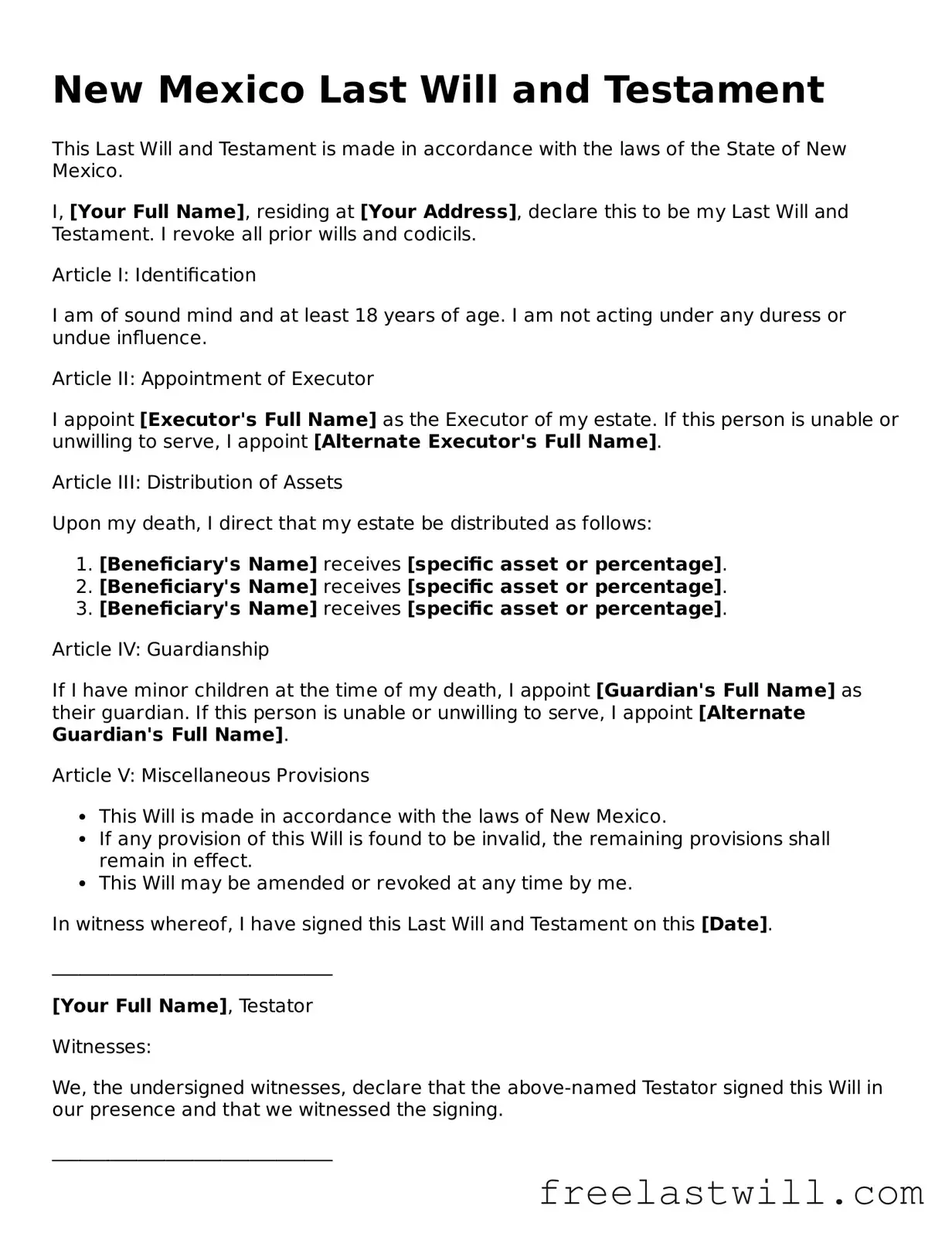
The New Mexico Last Will and Testament form shares similarities with a Living Will. A Living Will outlines an individual’s preferences regarding medical treatment in situations where they may be unable to communicate their wishes. Both documents serve to express a person’s intentions, but while a Last Will primarily deals with the distribution of assets after death, a Living Will focuses on healthcare decisions during a person’s lifetime. Each document provides clarity and guidance for loved ones, ensuring that personal wishes are respected in critical situations.
Another document comparable to the Last Will and Testament is the Durable Power of Attorney. This document allows an individual to appoint someone else to make financial or legal decisions on their behalf if they become incapacitated. Like a Last Will, a Durable Power of Attorney is designed to ensure that a person’s wishes are honored, but it operates during their lifetime rather than after death. Both documents are essential for effective estate planning and can help prevent disputes among family members.
The Revocable Trust is also similar to the Last Will and Testament. A Revocable Trust allows individuals to place their assets into a trust during their lifetime, which can then be managed by a trustee. Upon the individual’s death, the assets in the trust are distributed according to the terms of the trust, bypassing the probate process. Both documents aim to provide a clear plan for asset distribution, but a Revocable Trust offers additional benefits, such as privacy and potential tax advantages.
A Codicil is another document that can be associated with a Last Will. It serves as an amendment to an existing will, allowing individuals to make changes or updates without creating an entirely new document. This can include altering beneficiaries, changing the executor, or modifying specific bequests. Both a Codicil and a Last Will are crucial for ensuring that a person’s final wishes are accurately reflected and can adapt to changing circumstances in life.
The Advance Healthcare Directive is akin to the Last Will and Testament in that it addresses personal wishes regarding medical treatment. This document combines elements of a Living Will and a Durable Power of Attorney for healthcare decisions. It allows individuals to specify their preferences for medical care and appoint someone to make healthcare decisions on their behalf if they cannot do so. Both documents are vital for ensuring that a person’s values and desires are honored in medical situations.
A Guardianship Designation is another document that shares similarities with the Last Will. This document allows parents to appoint a guardian for their minor children in the event of their death or incapacity. Like a Last Will, it provides peace of mind by ensuring that children will be cared for according to the parents’ wishes. Both documents play a critical role in planning for the future and protecting loved ones.
The Estate Plan is a broader document that encompasses the Last Will and Testament, along with other components such as trusts, powers of attorney, and healthcare directives. An Estate Plan is designed to address all aspects of an individual’s financial and healthcare decisions, ensuring that their wishes are carried out comprehensively. While the Last Will focuses specifically on asset distribution after death, the Estate Plan provides a more holistic approach to planning for the future.
Finally, the Letter of Intent can be compared to the Last Will and Testament. This informal document allows individuals to express their wishes and intentions regarding their estate and personal matters. While it does not have the legal standing of a Last Will, it can provide valuable insights and guidance to loved ones. Both documents aim to communicate a person’s desires, helping to minimize confusion and conflict among family members after a person’s passing.