Legal Nevada Last Will and Testament Form Get This Document Online

Legal Nevada Last Will and Testament Form

A Nevada Last Will and Testament form is a legal document that outlines how an individual's assets and affairs should be handled after their passing. This form ensures that a person's wishes are honored, providing clarity and direction for loved ones during a difficult time. To get started on securing your legacy, fill out the form by clicking the button below.

Get This Document Online
Article Structure

Creating a Last Will and Testament is a crucial step in ensuring that your wishes are honored after your passing. In Nevada, this legal document serves as a formal declaration of how your assets should be distributed, who will care for any minor children, and who will execute your estate. The Nevada Last Will and Testament form includes essential components such as the appointment of an executor, the designation of beneficiaries, and provisions for guardianship. Additionally, it outlines specific bequests, allowing you to leave particular items or sums of money to chosen individuals or organizations. This form must meet certain requirements to be considered valid, including being signed by you and witnessed by at least two individuals. Understanding these aspects will help you navigate the process of creating a will that reflects your intentions and provides peace of mind for you and your loved ones.

Document Preview

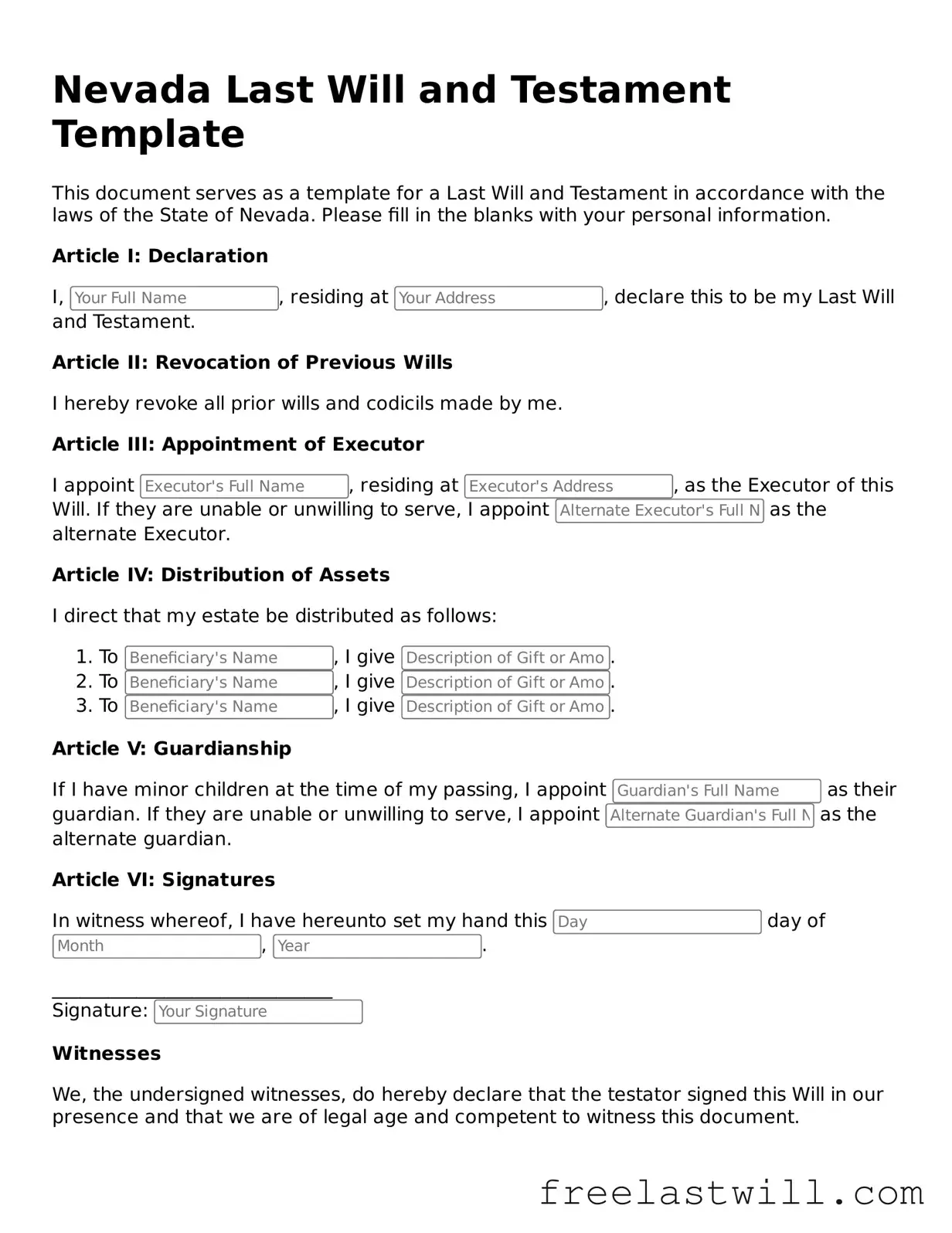
Nevada Last Will and Testament Template

This document serves as a template for a Last Will and Testament in accordance with the laws of the State of Nevada. Please fill in the blanks with your personal information.

Article I: Declaration

I, , residing at , declare this to be my Last Will and Testament.

Article II: Revocation of Previous Wills

I hereby revoke all prior wills and codicils made by me.

Article III: Appointment of Executor

I appoint , residing at , as the Executor of this Will. If they are unable or unwilling to serve, I appoint as the alternate Executor.

Article IV: Distribution of Assets

I direct that my estate be distributed as follows:

  1. To , I give .
  2. To , I give .
  3. To , I give .

Article V: Guardianship

If I have minor children at the time of my passing, I appoint as their guardian. If they are unable or unwilling to serve, I appoint as the alternate guardian.

Article VI: Signatures

In witness whereof, I have hereunto set my hand this day of , .

______________________________
Signature:

Witnesses

We, the undersigned witnesses, do hereby declare that the testator signed this Will in our presence and that we are of legal age and competent to witness this document.

  • ______________________________
    Witness 1:
  • ______________________________
    Witness 2:

Each witness certifies that they are not beneficiaries under this Will.

PDF Specifications

Fact Name Description
Governing Law The Nevada Last Will and Testament is governed by Nevada Revised Statutes (NRS) Chapter 133.
Age Requirement In Nevada, individuals must be at least 18 years old to create a valid will.
Signature Requirement The will must be signed by the testator (the person making the will) or by someone else in their presence and at their direction.
Witness Requirement At least two witnesses must sign the will for it to be valid, and they must be present at the same time.
Revocation A will can be revoked in Nevada by creating a new will or by physically destroying the original document.
Holographic Wills Nevada recognizes holographic wills, which are handwritten and do not require witnesses, as long as they are signed by the testator.

Instructions on Utilizing Nevada Last Will and Testament

After gathering the necessary information, you are ready to fill out the Nevada Last Will and Testament form. This form allows you to express your wishes regarding the distribution of your assets and the care of any dependents after your passing. Completing this document is an important step in ensuring that your intentions are honored.

  1. Begin by downloading the Nevada Last Will and Testament form from a reliable source or obtain a physical copy.
  2. At the top of the form, fill in your full legal name. Ensure that it matches your identification documents.
  3. Provide your current address. This should be your primary residence where you live.
  4. Next, specify the date on which you are completing the will. This is important for legal purposes.
  5. Designate an executor. This is the person who will carry out your wishes as outlined in the will. Include their full name and address.
  6. List your beneficiaries. These are the individuals or organizations you wish to inherit your assets. Clearly state their names and relationships to you.
  7. Detail the specific assets you wish to bequeath. This can include property, money, or personal belongings. Be as specific as possible.
  8. If you have minor children, appoint a guardian for them. Include the guardian's full name and relationship to you.
  9. Review the completed form for accuracy. Make sure all names and details are correct.
  10. Sign the document in the presence of at least two witnesses. They should also sign the form to validate it.
  11. Consider having the will notarized for added legal strength, although it is not required in Nevada.

Once the form is completed and signed, keep it in a safe place. Inform your executor and trusted family members about its location. This will help ensure that your wishes are followed when the time comes.

More About Nevada Last Will and Testament

What is a Last Will and Testament in Nevada?

A Last Will and Testament is a legal document that outlines how a person's assets and affairs should be handled after their death. In Nevada, this document allows individuals to specify who will inherit their property, name guardians for minor children, and appoint an executor to manage their estate. Creating a will ensures that your wishes are respected and can help prevent disputes among family members.

Who can create a Last Will and Testament in Nevada?

In Nevada, any adult who is at least 18 years old and of sound mind can create a Last Will and Testament. This means that the individual must understand the nature of the document and the implications of their decisions. Additionally, the will must be signed in the presence of at least two witnesses who are not beneficiaries. This requirement helps to validate the will and ensures that it reflects the true intentions of the person creating it.

What happens if I die without a will in Nevada?

If a person dies without a will, they are said to have died "intestate." In this situation, Nevada's intestacy laws will determine how their assets are distributed. Generally, the estate will be divided among surviving relatives according to a specific hierarchy, which may not align with the deceased's wishes. This can lead to complications and disputes among family members, making it all the more important to have a will in place.

Can I change my Last Will and Testament after it is created?

Yes, you can change your Last Will and Testament at any time while you are still alive and of sound mind. This is often done through a process called "codicil," which is an amendment to the original will. A codicil must be executed with the same formalities as the original will, including signatures and witnesses. Alternatively, you can create a completely new will that revokes the previous one. Regularly reviewing and updating your will ensures that it accurately reflects your current wishes and circumstances.

Common mistakes

  1. Not including all necessary information: It's crucial to provide complete details about your identity, including your full name, address, and date of birth. Omitting any of this information can lead to confusion or disputes later on.

  2. Failing to properly identify beneficiaries: Clearly naming beneficiaries is essential. Ensure that you specify who will receive your assets and include their full names and relationships to you to avoid ambiguity.

  3. Not signing the document: A will is not valid unless it is signed by you. Make sure to sign your will in the presence of witnesses, as required by Nevada law, to ensure its legality.

  4. Ignoring witness requirements: In Nevada, you need at least two witnesses to sign your will. Failing to have witnesses can render your will invalid, so ensure you follow this step carefully.

  5. Neglecting to update the will: Life changes such as marriage, divorce, or the birth of children may necessitate updates to your will. Regularly reviewing and revising your will helps reflect your current wishes.

  6. Using unclear language: Ambiguity can lead to disputes among beneficiaries. Use clear and straightforward language to express your intentions, ensuring that your wishes are understood.

  7. Not storing the will safely: After completing your will, it should be stored in a secure location. Inform your executor and trusted family members about where it is kept to avoid complications after your passing.

Documents used along the form

When creating a Nevada Last Will and Testament, several other documents may be useful in ensuring that your wishes are clearly expressed and legally binding. These forms can help address various aspects of estate planning and can complement your will. Here are five common documents often used alongside a Last Will and Testament:

  • Durable Power of Attorney: This document allows you to appoint someone to make financial and legal decisions on your behalf if you become incapacitated. It ensures that your affairs are managed according to your wishes even when you cannot act on your own.
  • Healthcare Power of Attorney: Similar to the Durable Power of Attorney, this form designates someone to make medical decisions for you if you are unable to do so. It is crucial for ensuring that your healthcare preferences are respected.
  • Living Will: A Living Will outlines your preferences regarding medical treatment and end-of-life care. It provides guidance to your loved ones and healthcare providers about your wishes in situations where you cannot communicate them.
  • Revocable Trust: This document allows you to place your assets into a trust during your lifetime, which can then be managed by a trustee. Upon your death, the assets can be distributed according to your instructions, often avoiding probate.
  • Beneficiary Designation Forms: Certain assets, like life insurance policies and retirement accounts, require specific beneficiary designations. These forms allow you to specify who will receive these assets upon your death, ensuring they go to the intended recipients.

Using these documents in conjunction with your Nevada Last Will and Testament can provide clarity and protection for your wishes. Each form serves a distinct purpose and can help ensure that your estate is managed according to your desires, both during your lifetime and after your passing.

Similar forms

The Nevada Last Will and Testament is similar to a Living Will, which outlines a person's preferences regarding medical treatment in the event they become incapacitated. While a Last Will focuses on the distribution of assets after death, a Living Will addresses health care decisions. Both documents serve to communicate an individual's wishes, ensuring that their desires are respected even when they cannot voice them. Having both documents in place provides a comprehensive approach to end-of-life planning.

Another document akin to the Nevada Last Will and Testament is a Trust. A Trust allows individuals to manage their assets during their lifetime and specifies how those assets should be distributed upon death. Unlike a Last Will, which goes through probate, a Trust can help avoid this lengthy process, offering a more private and efficient way to transfer assets. Both documents are essential for estate planning, but they serve different purposes and can complement each other effectively.

A Power of Attorney (POA) is also similar, as it designates someone to make decisions on behalf of another person. This can be for financial matters or health care. While a Last Will takes effect after death, a Power of Attorney is effective during a person's life, particularly if they become incapacitated. Having a POA in place ensures that someone trusted can manage affairs when one cannot, providing peace of mind alongside a Last Will.

The Advance Healthcare Directive shares similarities with the Last Will and Testament as well. This document combines elements of a Living Will and a Power of Attorney for health care, allowing individuals to specify their medical preferences and appoint a health care agent. Both documents aim to protect an individual's wishes regarding health care, ensuring that they receive the treatment they desire, even if they cannot communicate those wishes themselves.

A Codicil is another document related to a Last Will. It serves as an amendment to an existing will, allowing for changes without the need to create an entirely new document. This can include updates to beneficiaries, asset distribution, or any other terms of the will. While a Last Will establishes the original intentions, a Codicil allows for flexibility and adjustments as circumstances change in a person's life.

The Revocable Living Trust is closely aligned with the Nevada Last Will and Testament in that it provides a way to manage assets during one's lifetime and distribute them after death. This type of trust can be altered or revoked as needed, offering a level of control that a standard will does not. Both documents play vital roles in estate planning, with the Revocable Living Trust often functioning as a more dynamic tool for asset management.

Finally, a Declaration of Trust can be compared to a Last Will. This document establishes a trust and outlines its terms, similar to how a will specifies the distribution of an estate. While a Last Will comes into effect after death, a Declaration of Trust can be used during a person's life to manage assets. Both documents are integral to ensuring that an individual's wishes regarding their property and beneficiaries are honored, whether during their lifetime or after their passing.

Dos and Don'ts

When filling out the Nevada Last Will and Testament form, it is important to follow certain guidelines to ensure the document is valid and reflects your wishes. Below is a list of dos and don'ts to consider.

  • Do clearly identify yourself in the document, including your full name and address.
  • Do specify the distribution of your assets in detail to avoid confusion.
  • Do appoint an executor who will be responsible for carrying out your wishes.
  • Do sign the will in the presence of two witnesses who are not beneficiaries.
  • Don't use ambiguous language that could lead to misinterpretation.
  • Don't forget to date the will; this helps establish the most current version.
  • Don't make alterations or corrections without proper procedures, as this could invalidate the will.

Misconceptions

Understanding the nuances of a Last Will and Testament in Nevada is crucial for anyone looking to ensure their wishes are honored after they pass. However, several misconceptions can lead to confusion. Here are eight common myths about the Nevada Last Will and Testament form:

  1. Myth 1: A handwritten will is not valid in Nevada. Many believe that only typed wills are legally binding. In reality, Nevada recognizes holographic wills, which are handwritten and signed by the testator, as valid if they meet certain criteria.

  2. Myth 2: You need a lawyer to create a valid will. While having legal assistance can be beneficial, it is not mandatory. Individuals can create their own wills, provided they follow state laws and requirements.

  3. Myth 3: A will automatically avoids probate. Some think that simply having a will means their estate will bypass probate. However, all wills must go through probate to be validated and executed.

  4. Myth 4: Oral wills are valid in Nevada. It is a common belief that verbal instructions can serve as a will. In Nevada, oral wills are not recognized, making written documentation essential.

  5. Myth 5: You can disinherit your spouse without any repercussions. Many people assume that they can completely cut their spouse out of their will. In Nevada, spouses have certain rights that may allow them to claim a portion of the estate, regardless of the will's provisions.

  6. Myth 6: Once a will is created, it cannot be changed. This misconception can lead to outdated wills. In fact, wills can be modified or revoked at any time, as long as the testator is competent to do so.

  7. Myth 7: You must have witnesses to create a valid will. While having witnesses can strengthen a will's validity, Nevada allows for holographic wills to be valid without witnesses, provided they are signed and written by the testator.

  8. Myth 8: A will takes effect immediately upon signing. Some believe that signing a will means it is automatically in effect. In reality, a will only takes effect upon the death of the testator, at which point it must go through probate.

Understanding these misconceptions can empower individuals to make informed decisions about their estate planning. Clarity about the rules and requirements can help ensure that your final wishes are respected and carried out as intended.

Key takeaways

When filling out and using the Nevada Last Will and Testament form, it’s crucial to understand the key elements involved. Here are some important takeaways to keep in mind:

  • Understand the Purpose: A Last Will and Testament outlines how your assets will be distributed after your passing. It also allows you to name guardians for minor children.
  • Eligibility Requirements: You must be at least 18 years old and of sound mind to create a valid will in Nevada.
  • Clear Language: Use clear and simple language when specifying your wishes. Ambiguities can lead to disputes among heirs.
  • Witnesses Are Essential: Nevada requires at least two witnesses to sign your will. They must be present when you sign the document.
  • Consider Notarization: While not mandatory, having your will notarized can help validate it and may ease the probate process.
  • Review Regularly: Life changes, such as marriage, divorce, or the birth of a child, may necessitate updates to your will.
  • Keep It Safe: Store your will in a secure place, and inform trusted family members or friends about its location.

By following these guidelines, you can ensure that your Last Will and Testament serves its intended purpose and reflects your wishes accurately.

Legal Nevada Last Will and Testament Form

Get This Document Online