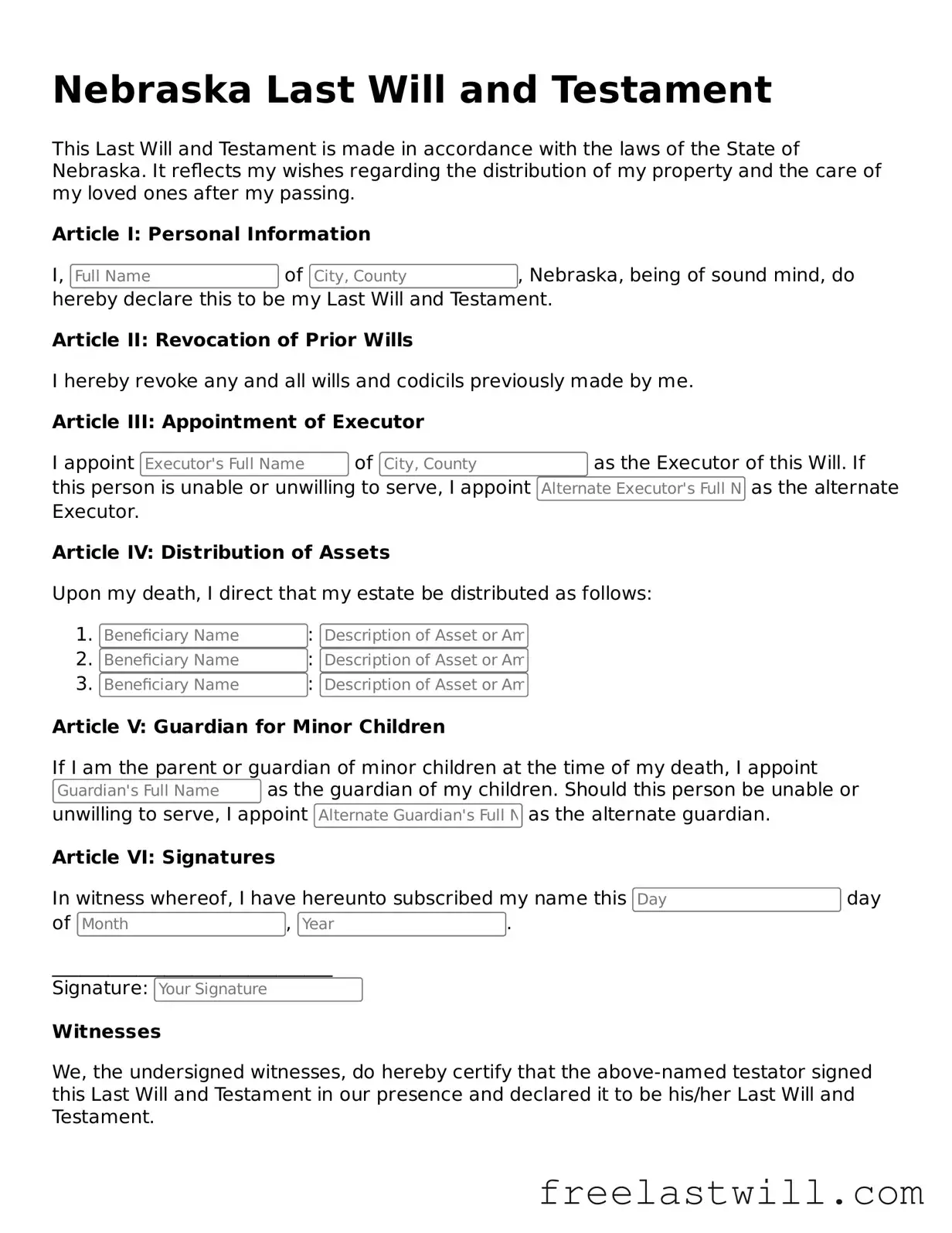
The Nebraska Last Will and Testament form is similar to the Living Will, which outlines an individual's preferences regarding medical treatment in the event they become incapacitated. While a Last Will and Testament deals primarily with the distribution of assets after death, a Living Will focuses on healthcare decisions. Both documents serve to express personal wishes, ensuring that an individual's intentions are respected, whether in life or after death.
Another related document is the Durable Power of Attorney. This legal form allows an individual to designate someone else to make financial or medical decisions on their behalf if they become unable to do so. Like a Last Will, it is crucial for ensuring that a person's preferences are honored. However, the Durable Power of Attorney becomes effective during the individual's lifetime, whereas a Last Will takes effect only after death.
The Revocable Trust, or Living Trust, is also comparable. This document allows a person to place their assets into a trust during their lifetime, which can then be managed by a trustee. Upon the individual's death, the assets are distributed according to the terms of the trust, bypassing probate. Both a Last Will and a Revocable Trust help manage the distribution of assets, but a trust can provide more privacy and may simplify the transfer process.
The Codicil is another document related to a Last Will. It serves as an amendment to an existing will, allowing changes to be made without creating an entirely new document. This can include modifications to beneficiaries or asset distribution. Both documents must adhere to specific legal requirements to be valid, ensuring that the individual's intentions are clearly documented.
The Advance Directive is similar in that it allows individuals to express their wishes regarding medical treatment and end-of-life care. This document can include both a Living Will and a Durable Power of Attorney for healthcare. While a Last Will focuses on asset distribution, an Advance Directive ensures that medical preferences are communicated and respected during critical health situations.
The Letter of Instruction can also be compared to a Last Will. While not a legally binding document, it provides guidance to loved ones regarding personal wishes, funeral arrangements, and asset distribution. It serves as a complement to a Last Will, offering additional context and clarity about the individual's desires.
The Estate Plan encompasses various documents, including a Last Will, Trusts, and Powers of Attorney. This comprehensive plan outlines how an individual's assets will be managed and distributed upon death or incapacity. Each component plays a distinct role in ensuring that the individual's wishes are fulfilled, much like the Last Will, which specifically addresses asset distribution.
The Beneficiary Designation form is another important document. It allows individuals to specify who will receive certain assets, such as life insurance policies or retirement accounts, upon their death. While a Last Will addresses the distribution of assets in a broader sense, beneficiary designations can take precedence over a will, making it essential to keep them updated and consistent with overall estate planning.
Finally, the Guardianship Designation form is relevant for parents or guardians of minor children. This document allows individuals to appoint a guardian for their children in the event of their death or incapacity. While a Last Will can include provisions for guardianship, a separate Guardianship Designation can provide clarity and ensure that the individual's wishes regarding their children's care are explicitly stated.