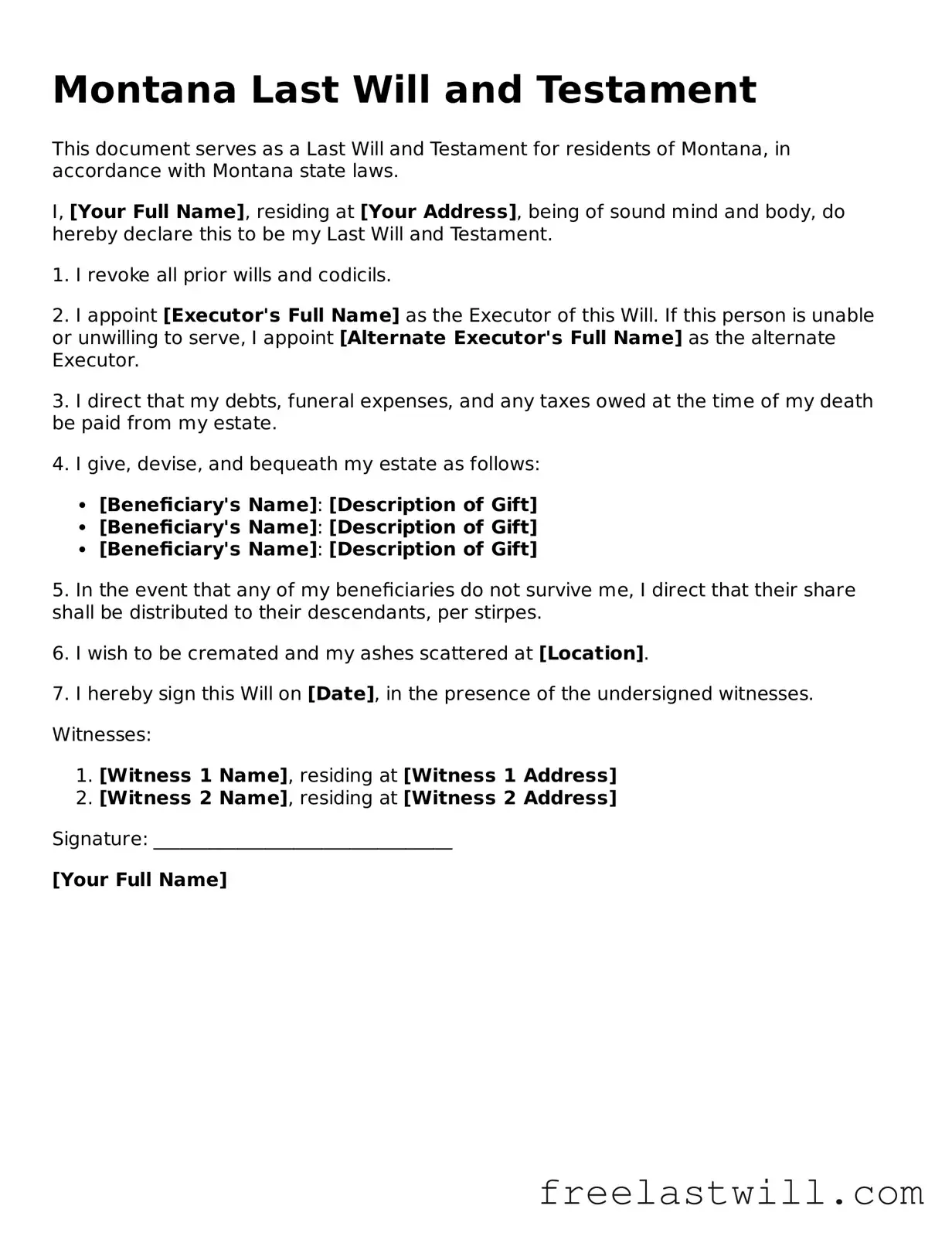
The Montana Last Will and Testament form is similar to a Living Will. A Living Will outlines a person's wishes regarding medical treatment in case they become unable to communicate. While a Last Will deals with the distribution of assets after death, a Living Will focuses on healthcare decisions during a person's life. Both documents are essential for ensuring that a person's wishes are respected, albeit in different contexts.
Another document that parallels the Last Will and Testament is a Revocable Trust. A Revocable Trust allows individuals to place their assets into a trust during their lifetime, which can be altered or revoked at any time. Like a Last Will, it specifies how assets will be distributed upon death. However, a Revocable Trust often helps avoid probate, making the distribution process smoother and faster for beneficiaries.
A Durable Power of Attorney is also similar to the Last Will and Testament. This document allows someone to appoint a trusted person to manage their financial affairs if they become incapacitated. While a Last Will comes into play after death, a Durable Power of Attorney is active during a person’s life, ensuring that their financial matters are handled according to their wishes.
The Advance Healthcare Directive shares similarities with the Last Will. This document combines a Living Will and a Durable Power of Attorney for healthcare. It allows individuals to specify their medical treatment preferences and appoint someone to make healthcare decisions on their behalf. Both documents ensure that a person's wishes are honored, focusing on different aspects of their care.
A Codicil is another document related to a Last Will and Testament. It serves as an amendment to an existing will, allowing changes without drafting a new will entirely. A Codicil can add, modify, or revoke provisions of the original will. This document ensures that updates to a person’s wishes are documented clearly while maintaining the original will's integrity.
Similar to a Last Will is the Letter of Instruction. This informal document provides additional guidance to executors and beneficiaries regarding personal matters, such as funeral arrangements or specific bequests. While not legally binding, it complements a Last Will by offering insights that can help family members and executors carry out the deceased's wishes more effectively.
The Estate Plan is a broader concept that encompasses the Last Will and Testament. An Estate Plan includes various documents, such as trusts, powers of attorney, and healthcare directives, to manage a person's assets and care during their life and after death. It provides a comprehensive approach to ensuring that a person's wishes are met in all aspects of their life and legacy.
A Beneficiary Designation is similar to the Last Will in that it specifies who will receive certain assets after death. This document is often used for life insurance policies, retirement accounts, and bank accounts. Unlike a Last Will, which covers all assets, beneficiary designations are specific to particular accounts and can bypass the probate process, ensuring quicker access to funds for beneficiaries.
The Joint Will is another document akin to the Last Will and Testament. It is created by two individuals, usually spouses, who agree to leave their assets to each other and then to their chosen beneficiaries. While a Last Will is typically a single person's declaration, a Joint Will serves as a mutual agreement, simplifying the estate planning process for couples.
Finally, a Trust Declaration is similar in purpose to a Last Will, as it outlines how assets will be distributed. This document creates a trust, which can be effective during a person's life or after their death. Trusts can provide more control over asset distribution and can help avoid probate, making them a popular alternative to traditional wills.