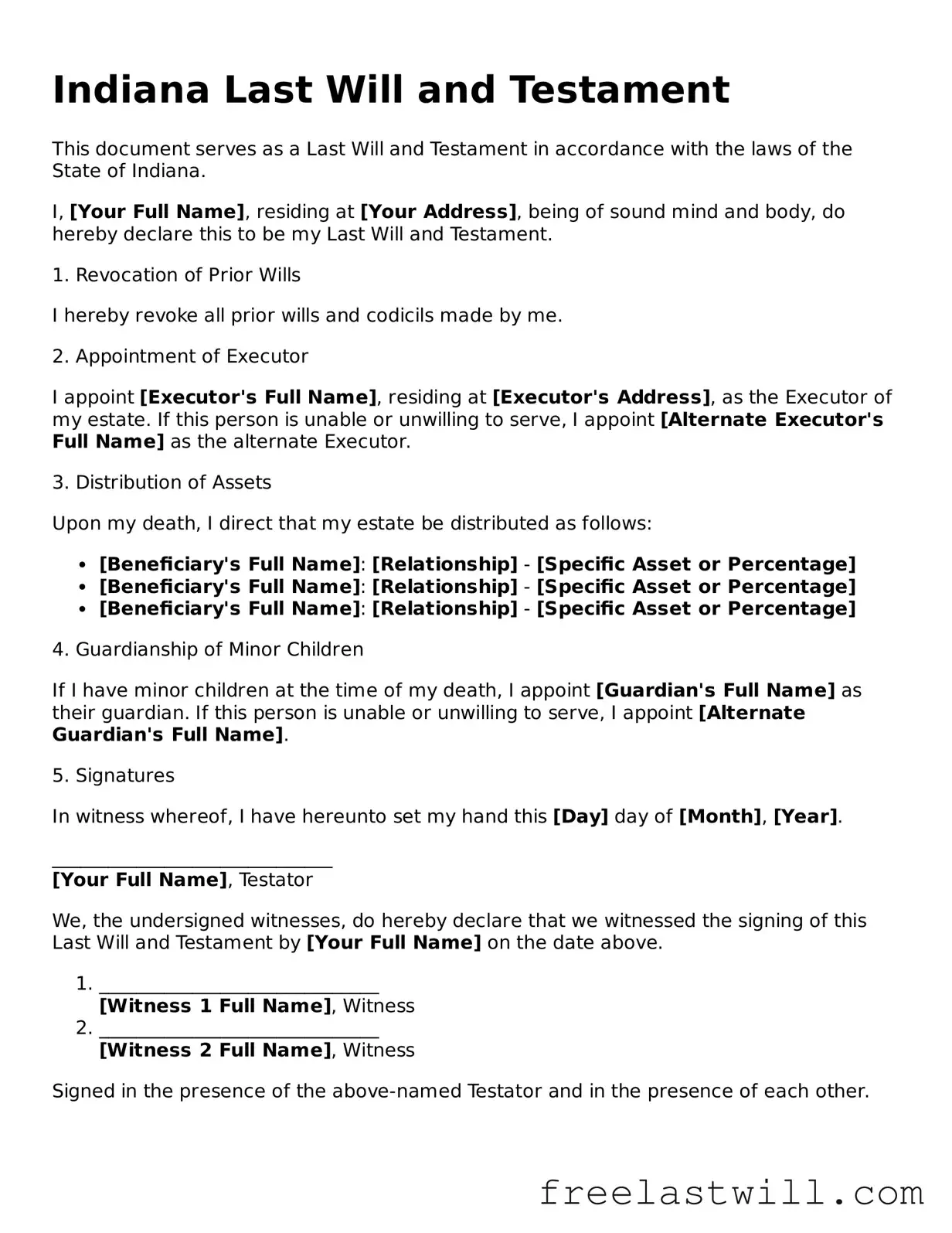
The Indiana Last Will and Testament form shares similarities with a Living Will. Both documents serve crucial roles in outlining an individual's wishes regarding their personal affairs. While the Last Will addresses the distribution of assets after death, a Living Will focuses on medical decisions when a person is incapacitated. Each document ensures that an individual's preferences are honored, either in life or after death.
Another document akin to the Indiana Last Will is a Durable Power of Attorney. This legal form allows an individual to designate someone to make decisions on their behalf, particularly in financial matters. Both documents empower individuals to control their affairs, ensuring that trusted persons manage their interests according to their wishes. The key difference lies in the timing; the Durable Power of Attorney is effective during the individual's life, while the Last Will takes effect after death.
The Indiana Last Will also resembles a Trust Agreement. Both documents can dictate how assets are managed and distributed. A Trust can take effect during a person’s lifetime and can provide more immediate benefits to beneficiaries, while a Last Will only comes into play after death. Trusts may also offer more privacy and flexibility in managing assets compared to a Last Will.
Another similar document is the Codicil. This is essentially an amendment to an existing Last Will. It allows individuals to make changes without drafting an entirely new will. Both documents must comply with state laws to be valid. A Codicil must be executed with the same formalities as a Last Will to ensure that the changes are legally enforceable.
A Health Care Proxy is another document that shares characteristics with the Indiana Last Will. Both allow individuals to express their wishes regarding personal matters. While a Health Care Proxy designates someone to make medical decisions on behalf of an individual, a Last Will outlines the distribution of property and assets after death. Each document ensures that a person's desires are respected, whether in health care or estate matters.
The Indiana Last Will is also similar to a Living Trust. Both documents facilitate the management and distribution of assets, but they do so in different ways. A Living Trust allows for the transfer of assets during a person's lifetime and avoids probate, while a Last Will only takes effect after death and typically requires probate proceedings. Both documents can work together to achieve comprehensive estate planning.
A Bill of Sale can also be compared to the Indiana Last Will, particularly in how both documents formalize the transfer of ownership. A Bill of Sale is used for the sale of personal property, while a Last Will governs the distribution of an estate. Both require clear intentions and signatures to be legally binding, ensuring that the wishes of the parties involved are respected.
The Affidavit of Heirship is another document that shares similarities with a Last Will. This affidavit is often used to establish the heirs of a deceased person when there is no will. Like a Last Will, it aims to clarify the distribution of assets. However, the Affidavit of Heirship is typically used in situations where a will is absent, providing a legal declaration of who inherits the estate.
Lastly, a Quitclaim Deed has some parallels with the Indiana Last Will. Both documents are used to transfer property rights. A Quitclaim Deed transfers ownership without guaranteeing the title, while a Last Will specifies how property should be distributed after death. Both require careful consideration and clear documentation to ensure the intentions of the parties are honored.